"

Gcse

Pht

Showing posts with label Diabetes. Show all posts

Sugar May Be Bad, But This Sweetener Called Fructose Is Far More Deadly


A 2009 study from University of California, Davis takes its place in a growing lineup of scientific studies demonstrating that consuming high-fructose corn syrup is the fastest way to trash your health. It is now known without a doubt that sugar in your food, in all its myriad of forms, is taking a devastating toll.
And fructose in any form -- including high-fructose corn syrup (HFCS) and crystalline fructose -- is the worst of the worst! Fructose, a cheap sweetener usually derived from corn, is used in thousands of food products and soft drinks. Excessive fructose consumption can cause metabolic damage and triggers the early stages of diabetes and heart disease, which is what the Davis study showed.
Dr. Richard Johnson also does a fabulous job of comprehensively reviewing this important topic in his new book The Fat Switch. In the study, over the course of 10 weeks, 16 volunteers on a controlled diet including high levels of fructose produced new fat cells around their heart, liver, and other digestive organs. They also showed signs of food-processing abnormalities linked to diabetes and heart disease. Another group of volunteers on the same diet, but with glucose sugar replacing fructose, did not have these problems. Fructose is a major contributor to:
  • Insulin resistance and obesity
  • Elevated blood pressure
  • Elevated triglycerides and elevated LDL
  • Depletion of vitamins and minerals
  • Cardiovascular disease, liver disease, cancer, arthritis, and even gout

A Calorie Is Not a Calorie

Glucose is the form of energy you were designed to run on. Every cell in your body, every bacterium -- and in fact, every living thing on Earth -- uses glucose for energy.
If you received your fructose only from vegetables and fruits (where it originates) as most people did a century ago, you'd consume about 15 grams per day -- a far cry from the 73 grams per day the typical adolescent gets from sweetened drinks. In vegetables and fruits, it's mixed in with fiber, vitamins, minerals, enzymes, and beneficial phytonutrients, all which moderate any negative metabolic effects.
It isn't that fructose itself is bad -- it is the MASSIVE DOSES you're exposed to that make it dangerous. There are two reasons fructose is so damaging:
  1. Your body metabolizes fructose in a much different way from glucose. The entire burden of metabolizing fructose falls on your liver.
  2. People are consuming fructose in enormous quantities, which has made the negative effects much more profound.
Today, 55 percent of sweeteners used in food and beverage manufacturing are made from corn, and the number one source of calories in America is soda, in the form of HFCS.
Food and beverage manufacturers began switching their sweeteners from sucrose (table sugar) to corn syrup in the 1970s when they discovered that HFCS was not only far cheaper to make, but is also about 20% sweeter than table sugar. HFCS is either 42% or 55% fructose, and sucrose is 50% fructose, so it's really a wash in terms of sweetness.
Still, this switch drastically altered the average American diet.
By USDA estimates, about one-quarter of the calories consumed by the average American is in the form of added sugars, and most of that is HFCS. The average Westerner consumes a staggering 142 pounds a year of sugar! And the very products most people rely on to lose weight -- the low-fat diet foods -- are often the ones highest in fructose. Making matters worse, all of the fiber has been removed from these processed foods, so there is essentially no nutritive value at all.

Fructose Metabolism Basics

Without getting into the very complex biochemistry of carbohydrate metabolism, it is important to understand some differences about how your body handles glucose versus fructose. I will be publishing a major article about this in the next couple of months, which will get much more into the details. But for our purpose here, I will just summarize the main points.
Dr. Robert Lustig, Professor of Pediatrics in the Division of Endocrinology at the University of California, San Francisco, has been a pioneer in decoding sugar metabolism. His work has highlighted some major differences in how different sugars are broken down and used:
  • After eating fructose, 100 percent of the metabolic burden rests on your liver. But with glucose, your liver has to break down only 20 percent.
  • Every cell in your body, including your brain, utilizes glucose. Therefore, much of it is "burned up" immediately after you consume it. By contrast, fructose is turned into free fatty acids (FFAs), VLDL (the damaging form of cholesterol), and triglycerides, which get stored as fat.
  • The fatty acids created during fructose metabolism accumulate as fat droplets in your liver and skeletal muscle tissues, causing insulin resistance and non-alcoholic fatty liver disease (NAFLD). Insulin resistance progresses to metabolic syndrome and type II diabetes.
  • Fructose is the most lipophilic carbohydrate. In other words, fructose converts to activated glycerol (g-3-p), which is directly used to turn FFAs into triglycerides. The more g-3-p you have, the more fat you store. Glucose does not do this.
  • When you eat 120 calories of glucose, less than one calorie is stored as fat. 120 calories of fructose results in 40 calories being stored as fat. Consuming fructose is essentially consuming fat!
  • The metabolism of fructose by your liver creates a long list of waste products and toxins, including a large amount of uric acid, which drives up blood pressure and causes gout.
  • Glucose suppresses the hunger hormone ghrelin and stimulates leptin, which suppresses your appetite. Fructose has no effect on ghrelin and interferes with your brain's communication with leptin, resulting in overeating.
If anyone tries to tell you "sugar is sugar," they are way behind the times. As you can see, there are major differences in how your body processes fructose and glucose. The bottom line is: fructose leads to increased belly fat, insulin resistance, and metabolic syndrome -- not to mention the long list of chronic diseases that directly result. And eating sugar may accelerate the aging process itself.

Panic in the Corn Fields

As the truth comes out about HFCS, the Corn Refiners Association is scrambling to convince you that their product is equal to table sugar, that it is "natural" and safe. Of course, many things are "natural" -- cocaine is natural, but you wouldn't want to use 142 pounds of it each year.
The food and beverage industry doesn't want you to realize how truly pervasive HFCS is in your diet -- not just from soft drinks and juices, but also in salad dressings and condiments and virtually every processed food. The introduction of HFCS into the Western diet in 1975 has been a multi-billion dollar boon for the corn industry.
The FDA classifies fructose as GRAS: Generally Regarded As Safe. Which pretty much means nothing and is based on nothing. There is plenty of data showing that fructose is not safe -- but the effects on the nation's health have not been immediate. That is why we are just now realizing the effects of the last three decades of nutritional misinformation. As if the negative metabolic effects are not enough, there are other issues with fructose that disprove its safety:
  • More than one study has detected unsafe mercury levels in HFCS.
  • Crystalline fructose, a super-potent form of fructose the food and beverage industry is now using, may contain arsenic, lead, chloride and heavy metals
  • Nearly all corn syrup is made from genetically modified corn, which comes with its own set of risks.
The FDA isn't going to touch sugar, so it's up to you to be proactive about your own dietary choices. For a real eye-opener about what sugar has down to the health of America, I recommend watching a piece that 60 Minutes did on this issue.

What's a Sugarholic to Do?

Ideally, I recommend that you avoid as much sugar as possible. This is especially important if you are overweight or have diabetes, high cholesterol, or high blood pressure. I also realize we don't live in a perfect world, and following rigid dietary guidelines is not always practical or even possible. If you want to use a sweetener occasionally, this is what I recommend:
  1. Use the herb stevia.
  2. Use organic cane sugar in moderation.
  3. Use organic raw honey in moderation.
  4. Avoid ALL artificial sweeteners, which can damage your health even more quickly than fructose.
  5. Avoid agave syrup since it is a highly processed sap that is almost all fructose. Your blood sugar will spike just as it would if you were consuming regular sugar or HFCS. Agave's meteoric rise in popularity is due to a great marketing campaign, but any health benefits present in the original agave plant are processed out.
  6. Avoid so-called energy drinks and sports drinks because they are loaded with sugar, sodium, and chemical additives. Rehydrating with pure, fresh water is a better choice.
If you or your child is involved in athletics, I recommend you read my article Energy Rules for some great tips on how to optimize your child's energy levels and physical performance through good nutrition.

Did You Know?

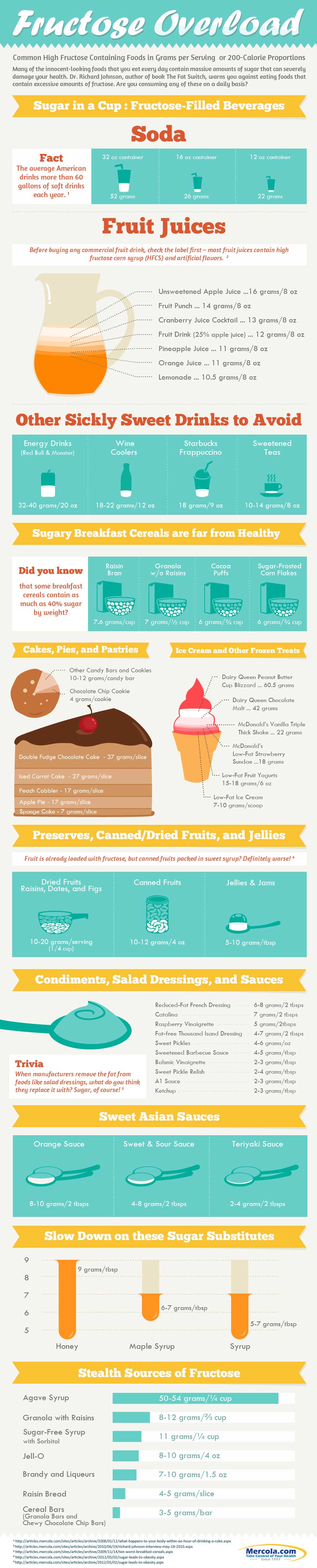
fructose overload infographic

What Else Does the Science Say About the Health Impact of Fructose?

According to GreenMedInfo.com, scientific studies have linked fructose to about 30 different specific diseases and health problems. Select the hyperlinks provided to review how fructose may:
Raise your blood pressure, and cause nocturnal hypertension Insulin resistance / Type 2 Diabetes Non-alcoholic fatty liver disease (NAFLD)
Raise your uric acid levels, which can result in gout and/or metabolic syndrome Accelerate the progression of chronic kidney disease Intracranial atherosclerosis (narrowing and hardening of the arteries in your skull)
Exacerbate cardiac abnormalities if you're deficient in copper Have a genotoxic effect on the colon Promote metastasis in breast cancer patients
Cause tubulointerstitial injury (injury to the tubules and interstitial tissue of your kidney) Promotes obesity and related health problems and diseases Promotes pancreatic cancer growth and feeds cancer cells in general
Cause your brain neurons to stagnate    

In Diabetes, a Complex of Causes and Its Treatment

Diabetes is usually a lifelong (chronic) disease in which there is a high level of sugar in the blood.

Causes

Insulin is a hormone produced by the pancreas to control blood sugar. Diabetes can be caused by too little insulin, resistance to insulin, or both.
To understand diabetes, it is important to first understand the normal process by which food is broken down and used by the body for energy. Several things happen when food is digested:
  • A sugar called glucose enters the bloodstream. Glucose is a source of fuel for the body.
  • An organ called the pancreas makes insulin. The role of insulin is to move glucose from the bloodstream into muscle, fat, and liver cells, where it can be used as fuel.
     

People with diabetes have high blood sugar because their body cannot move sugar into fat, liver, and muscle cells to be stored for energy. This is because either:
  • Their pancreas does not make enough insulin
  • Their cells do not respond to insulin normally
  • Both of the above
There are two major types of diabetes. The causes and risk factors are different for each type:


  • Type 1 diabetes can occur at any age, but it is most often diagnosed in children, teens, or young adults. In this disease, the body makes little or no insulin. Daily injections of insulin are needed. The exact cause is unknown.
  • Type 2 diabetes makes up most diabetes cases. It most often occurs in adulthood. But because of high obesity rates, teens and young adults are now being diagnosed with it. Many people with type 2 diabetes do not know they have it.
  • There are other causes of diabetes, and some patients cannot be classified as type 1 or type 2.
Gestational diabetes is high blood sugar that develops at any time during pregnancy in a woman who does not have diabetes.
Diabetes affects more than 20 million Americans. Over 40 million Americans have pre-diabetes (which often develops before type 2 diabetes). If your parent, brother or sister has diabetes, you may be more likely to develop diabetes.

Symptoms

High blood sugar level can cause several symptoms, including:
  • Blurry vision
  • Excess thirst
  • Fatigue
  • Hunger
  • Urinating often
  • Weight loss
Because type 2 diabetes develops slowly, some people with high blood sugar have no symptoms.
Symptoms of type 1 diabetes develop over a short period. People may be very sick by the time they are diagnosed.
After many years, diabetes can lead to other serious problems. These problems are known as diabetes complications and include:
  • Eye problems, including trouble seeing (especially at night), light sensitivity, blindness in the future
  • Painful sores and infections of the leg or foot, which if left untreated, leads to removal of the foot or leg 
  • Nerves in the body can become damaged, causing pain, tingling, and a loss of feeling, problems digesting food, erectile dysfunction
  • Kidney problems, which can lead to kidney failure
  • Weakened immune system, which can lead to more frequent infections
  • Increased chance of having a heart attack or stroke

Exams and Tests

A urine analysis may show high blood sugar. But a urine test alone does not diagnose diabetes.
Your health care provider may suspect that you have diabetes if your blood sugar level is higher than 200 mg/dL. To confirm the diagnosis, one or more of the following tests must be done.
Blood tests:
  • Fasting blood glucose level -- diabetes is diagnosed if it is higher than 126 mg/dL twice. Levels between 100 and 126 mg/dL are called impaired fasting glucose or pre-diabetes. These levels are risk factors for type 2 diabetes.
  • Hemoglobin A1c test --
    • Normal: Less than 5.7%
    • Pre-diabetes: 5.7% - 6.4%
    • Diabetes: 6.5% or higher
  • Oral glucose tolerance test -- diabetes is diagnosed if glucose level is higher than 200 mg/dL 2 hours after drinking a glucose drink. (This test is used more often for type 2 diabetes.)
Screening for type 2 diabetes in people who have no symptoms is recommended for:
  • Overweight children who have other risk factors for diabetes, starting at age 10 and repeated every 2 years
  • Overweight adults (BMI greater than 25) who have other risk factors
  • Adults over age 45, repeated every 3 years 

Treatment

With type 2 diabetes, the disease may be reversed with lifestyle changes, especially losing weight through exercising and eating healthier foods.  Also, some cases of type 2 diabetes can be improved with weight-loss surgery.
There is no cure for type 1 diabetes.
Treating both type 1 diabetes and type 2 diabetes involves medicines, diet, and exercise to control blood sugar level.
Getting better control over your blood sugar, cholesterol, and blood pressure levels helps reduce the risk of kidney disease, eye disease, nervous system disease, heart attack, and stroke.
To prevent diabetes complications, visit your health care provider at least two to four times a year. Talk about any problems you are having. Follow your health care provider's instructions on managing your diabetes.